
Micro and Macro-Scaled Upsizing to Simplify and Enhance Planetary Life, Part 5
Upscaling individual and collective efforts in seeking quality over quantity

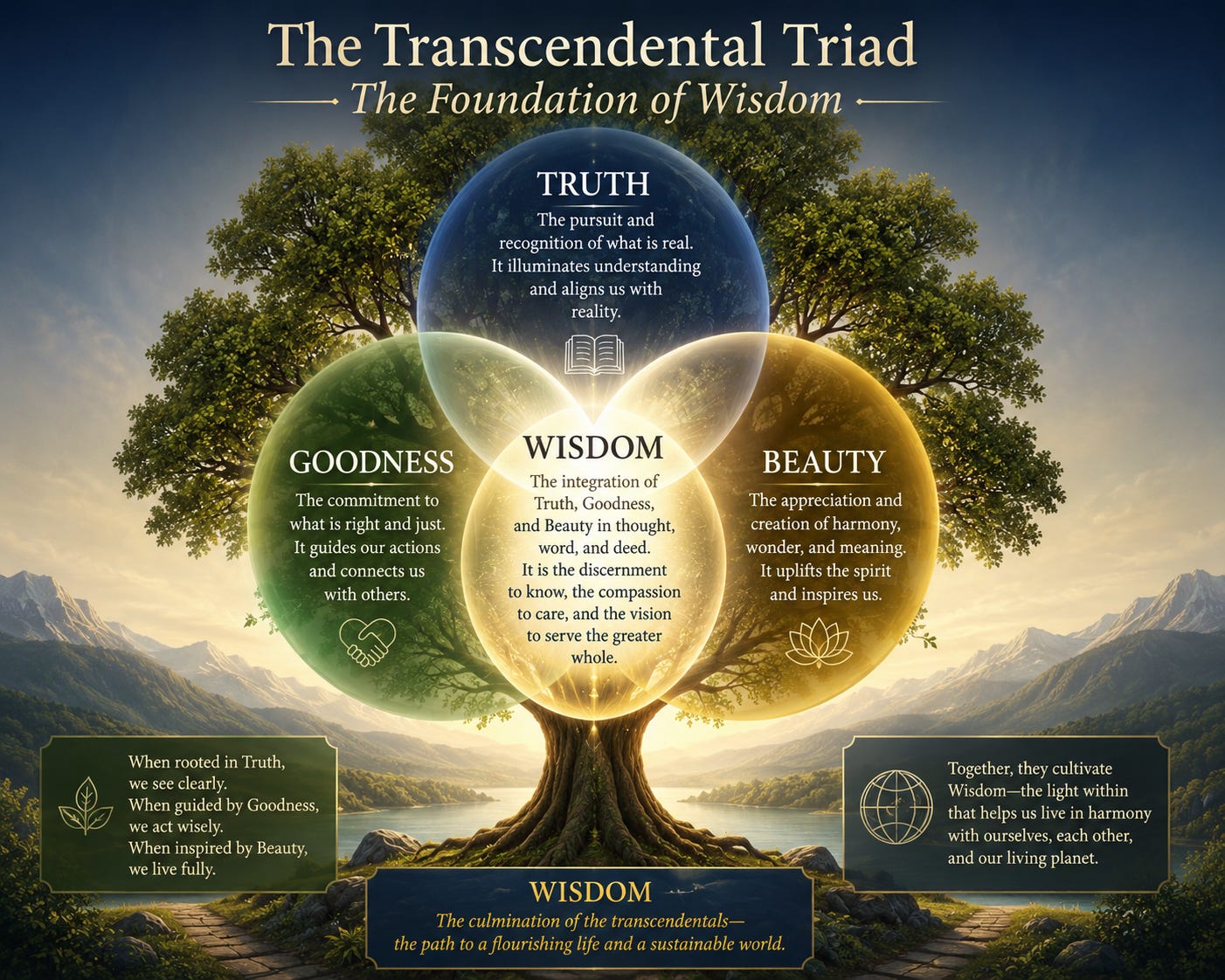
Image (ChatGPT): Truth, Goodness, and Beauty—Foundations of Wisdom for Downsizing and Upsizing
Recap / Update—from Downsizing to Upsizing
You may be pleased to learn that this is the final post in a five-part series devoted to downsizing, from micro (individual) to macro (societal) levels. If you haven’t perused the previous four parts and are interested in reviewing them, here are the links: Part 1; Part 2; Part 3; and Part 4.
While the term downsizing has been used widely throughout this series of posts, the opposite term—upsizing—has been saved for this final part. Synonyms include growing, increasing, expanding, andupgrading. Most physical entities can be downsized but fewer can be intentionally upsized, especially limited extractable natural materials, like fossil fuels and minerals.
So, here we address how individuals and society can upsize relevant entities, both physical (corporeal) and nonphysical (incorporeal). Nonphysical entities lack mass, form, or tangible existence, such as beliefs, dreams, memories, ideas, emotions, and concepts, like gravity.
What about behavior? Depending on the scientific or philosophical framework used for analysis, behavior may be considered both a physical and a nonphysical reality. Any human action combines specific physical actions involving muscular movements, vocalizations, and physiological changes, along with nonphysical mental or functional processes.
In most life situations and circumstances, the saying “thought precedes action” applies, as when we’re motivated to achieve a meaningful, purposeful goal. When actions precede thoughts, there are usually reflexive reactions, as when an unexpected threatening action stimulates a fight-or-flight response.
The simple point I’m trying to convey is that certain behaviors need downsizing, and others need upsizing. To this point the focus of this five-part series has been on physical-and-nonphysical downsizing actions individuals and society can undertake.
We now consider the actions people can take to upsize the physical (quantitative) and nonphysical (qualitative) aspects of life that can guide humanity on a long-term intentional path dedicated to assuring a livable and, hopefully, sustainable existence on Spaceship Earth. For all lifeforms.
Forms of Physical (Quantitative) Upsizing
A guideline for upsizing might be that of seeking and emphasizing quality over quantity. A cautionary principle suggests that, whenever upsizing the quantity of anything—for instance, extreme polarizing rhetoric or consumption of fossil fuels—averting potential downside outcomes requires careful consideration and preparation.
Human population. This cautionary principle is particularly applicable when determining a sustainable size of our human population. Because we humans are the planet’s apex predator species, population experts argue for downsizing, not upsizing our numbers.
Commonly referred to as the “elephant-in-the-room” topic, this refers to a majority of people who readily deny, avoid, or misunderstand the human population issue. I’ve mentioned previously that, for substantive reasons not discussed here, downsizing our population is an essential strategy for creating a sustainable future, not only quantitatively but more so qualitatively.
Population experts strongly recommend upsizing efforts to educate global citizens regarding the benefits of a smaller human population. A sustainable-sized population will help in upsizing the quality of life, not only for humans but also for all other species. A global population of 1-2 billion people would have a long-term positive impact, greatly reducing consumption and waste products and slowing ecological degradation, allowing the bio-ecosphere to regenerate.
Of course, only humane strategies should be used in reducing human population. Recommended approaches emphasize: empowerment of women; universal reproductive healthcare; comprehensive sex education; reduction in child mortality; and non-coercive economic incentives.
The most constructive impacts from upsizing strategies would be the qualitative restoration and regeneration of all life-sustaining sources—clean air, available water, healthy soil, renewable natural resources (forests, wetlands, arable lands) and the regeneration of all endangered flora, fauna, and fungi species.
Appropriate technologies. Other physical-upsizing examples might be for society to depend more on using low-tech tools and equipment, and mid-to-high-tech equipment designed to provide more efficient low-energy consumption methods for major needs. To reduce energy usage, the technologies of solar, wind, and geothermal power sources could serve well. Upsizing more sensible attitudes and constructive ways of using electronic devices (computers, cell phones, television, etc.) might also be a possible worthy goal.
Ecological economic models: Rather than continuing our current pro-growth, profit-driven economic system driven by Gross Domestic Product (GDP), it would be wise to consider optional models with the potential of creating a sustainable existence—for humans and the rest of Nature.
The only systems that provide hope for upsizing the potential for a sustainable future are those that prioritize the “R” practices of reusing, repurposing, repairing, and recycling materials for the purpose of minimizing virgin extraction. The most trustworthy ecological-economic models are Circular Economy, Donut Economics, and Steady-State Economy
Non-human lifeforms. In turning attention to the forms of upsizing applicable in supporting biological lifeforms (flora, fauna, and fungi), it’s important to realize that, in addition to Nature’s regeneration, beneficial growth also depends on our assistance; first, by allowing all forms to exist and flourish in their natural state; and, second, by our helping to restore and rejuvenate systems we’ve degraded. This concept requires envisioning and implementing a sustainable way of living with Nature that minimizes human intrusions.
Biomimicry and sustainable design. Employing methods like bio-mimicry and sustainable design that integrate materials with natural cycles and avoid creating long-term waste can provide effective ways for achieving beneficial material upscaling. In sum, employing more low-energy sources and technologies to replace high-energy sources may be considered an effective form of positive physical growth.
Practices For Restoring and Regenerating Natural Systems. Restoring Nature begins with cleaning up the planet’s water, soil, and air, which will necessitate vastly reducing fossil-fuel burning, consumption of natural materials, and production of toxic waste products. It will also require upsizing the limits and practices that help protect, conserve, and preserve vital land and water systems, beginning with minimizing human activities in fragile ecosystems, particularly wilderness areas.
Regenerative agriculture, a holistic approach focused on improving soil health, biodiversity, and ecosystem resilience can be achieved through techniques such as those listed below. Regenerative farming also aims to sequester carbon and improve water retention.
Principal forms of regenerating natural systems via food-growing systems include: Cover Cropping, involving the planting of crops during off-seasons to prevent erosion, add organic matter, and improve soil fertility; Crop Rotation, an approach that alternates crop types each season to reduce pests, prevent nutrient depletion, and improve soil fertility; No-Till or Reduced Tillage Farming, a system that minimizes soil disturbance, by preserving soil structure, preventing erosion, and maintaining carbon storage of soil; Rotational Grazing, the moving of livestock to prevent overgrazing, support soil health, and lower carbon emissions; and Water Management Techniques that optimize water use, reduce erosion, and improve soil moisture through methods like contour farming and rainwater harvesting.
Other prominent natural regeneration systems include: Permaculture, a design system to create sustainable human settlements and agricultural systems that imitate natural ecosystems, with guiding principles that include observing nature, capturing energy, producing no waste, and valuing diversity; Agroecology, an integrated approach that applies ecological and social concepts to food and agricultural-system management, focusing on interactions between plants, animals, humans, and the environment for sustainable and fair systems; Agroforestry, the integration of trees and shrubs into agricultural systems to boost biodiversity, strengthen soil health, and control erosion; Ecological Restoration, the scientific study of restoring degraded ecosystems, including reforestation, wetland restoration, and soil remediation; and Bioregionalism, a major movement in ecological restoration and rejuvenation.
Forms of Nonphysical (Qualitative) Upsizing
It’s refreshing to finally acknowledge a plethora of non-physical qualitative topics that counter the harmful nonphysical forms of upsizing. The following familiar forms of positive upsizing illustrate how anyone can devote more time and effort in countering the harmful forms presented in previous posts featuring material-downsizing actions.
Educational enrichment and enlightenment. Of all the existing sociocultural self-improvement systems, a humane educational system that begins in childhood and continues throughout life may be the most effective means for promoting nonphysical qualitative growth. The principal knowledge and skills provided in a “lifelong learning system” promote scientific literacy, critical thinking, creativity, and ecological awareness. These four areas offer metaphorical windows and doors through which flows in-depth, introductory exposure to a wide range of topics, all of which help us become more virtuous, curious, empathetic, grateful, and healthy.
The overall goal is to develop socio-ecologically conscious humans who comprehend the complex interconnections of social and ecological systems. I find that attaining such a lofty goal begins with appreciating and honoring the three transcendental properties of Truth (reality), Goodness (morality), and Beauty (quality). Understanding these properties can help shape the thoughts, concepts, values, and behaviors that will influence the future quality of life on Earth tor years come.
As the illustration above suggests, what humanity drastically needs is a liberal dose of wisdom, the ability to apply knowledge and experience in making reliable judgements and decisions based on informed insight, discernment, and moral-ethical considerations.
Promotion of justice, equality, and equity. At this historical turning point, with liberal democracy confronted by aggressive, right-wing authoritarian extremism, any ideas and actions that can strengthen democracy and the common good need implementing. One way to promote good growth would be to promote egalitarian social structures and the rights of minority groups, including Indigenous peoples. Moreover, equitably sharing the wealth of Nature and the global economy among all world citizens, especially the impoverished masses, would serve to enhance the common good, not only for humans but for all species.
Rights of Nature and recognition of all beings. Moving beyond hubristic anthropocentrism requires acknowledging and honoring all biological and environmental systems as morally legal entities, by acknowledging their intrinsic values and full rights to exist and flourish. Overcoming our modern alienation from the natural world—a disconnect encompassing cognitive, emotional, and behavioral aspects—may well be the number-one challenge. Hence, any form of qualitative upsizing capable of nudging more humans towards promoting the values of Nature deserves pursuing.
Cross-cultural empathy and dialogue. Creating a global cultural framework is an essential societal goal, whereby different worldviews and traditions are respected, contribute to, and share a sustainability ethic. Of special importance is the concept of judging others not by the color of their skin, socio-ethnic background, social class, or socio-economic status, but rather by the moral content of their character and quality of behavior. As a universal principle, the Golden Rule (”Treat others as you wish to be treated.”) presents a practical moral-ethical guide for promoting compassionate behavior.
Well-being metrics over GDP. Priorities should focus on upsizing qualitative conditions in all areas of life—health, leisure, meaningful work, creative endeavors, psycho-emotional fulfillment, and community vitality. The commercial metric of GDP (Gross Domestic Product) has proven an insufficient method for measuring such positive qualities. In order to obtain a more comprehensive view of development and ensure informed policies, alternative metrics are needed that complement GDP’s prioritization of economic material growth.
Fortunately, there are two worthy countering measurements: Bhutan’s Gross National Happiness (GNH), which considers factors like equitable socioeconomic development and good governance, and UNDP’s Human Development Index (HDI), which encapsulates (apart from economic prosperity) health and knowledge issues.
Wrap up
I assume most readers will agree with the basic substance and intent of information covered in this five-part downsizing-upsizing series. If not, I welcome critical feedback—as long as it is founded on scientific evidence, and avoids any irrational form, especially escapism or denialism.
The foundational theme of this series simply emphasizes that, if humans wish to live in harmony with the rest of the natural world, we must learn to live with having “enough”, a sufficiency of physical “needs” rather than excessive “wants”. Truthfully, the concept of downsizing does not sit well with those of us accustomed to having ample access to material goods and modern conveniences.
Of all the nonphysical, qualitative upsizing measures discussed thus far, wisdom is the most essential quality needing upsizing. We humans may be a super-intelligent species, but we are not wise beings. Wisdom requires a combination of all positive virtues, qualities, and characteristics, including: compassion for all living things; cooperation with other beings; ecological awareness, respect, appreciation, and gratitude for all that exists; and, finally, steadfast devotion to the transcendental properties of Truth, Goodness, and Beauty, the ultimate qualities of being.
This concludes our downsizing-and-upsizing exploration. I’m not sure what comes next; perhaps a few weeks enjoying the final weeks of summer, with fewer postings. In the meantime, let’s make the most of our time on Earth while we’re still able; by downsizing the negative attributes of life and upsizing the positive ones.
Yours, in Truth, Goodness, and Beauty . . .
Clif (with Bettye Ware, reader/editor/partner)
Bravo Clif!