
Downsizing to Simplify and Enhance Life, Part 2
Maximizing the quality of life’s “needs” by minimizing material and emotional “wants”

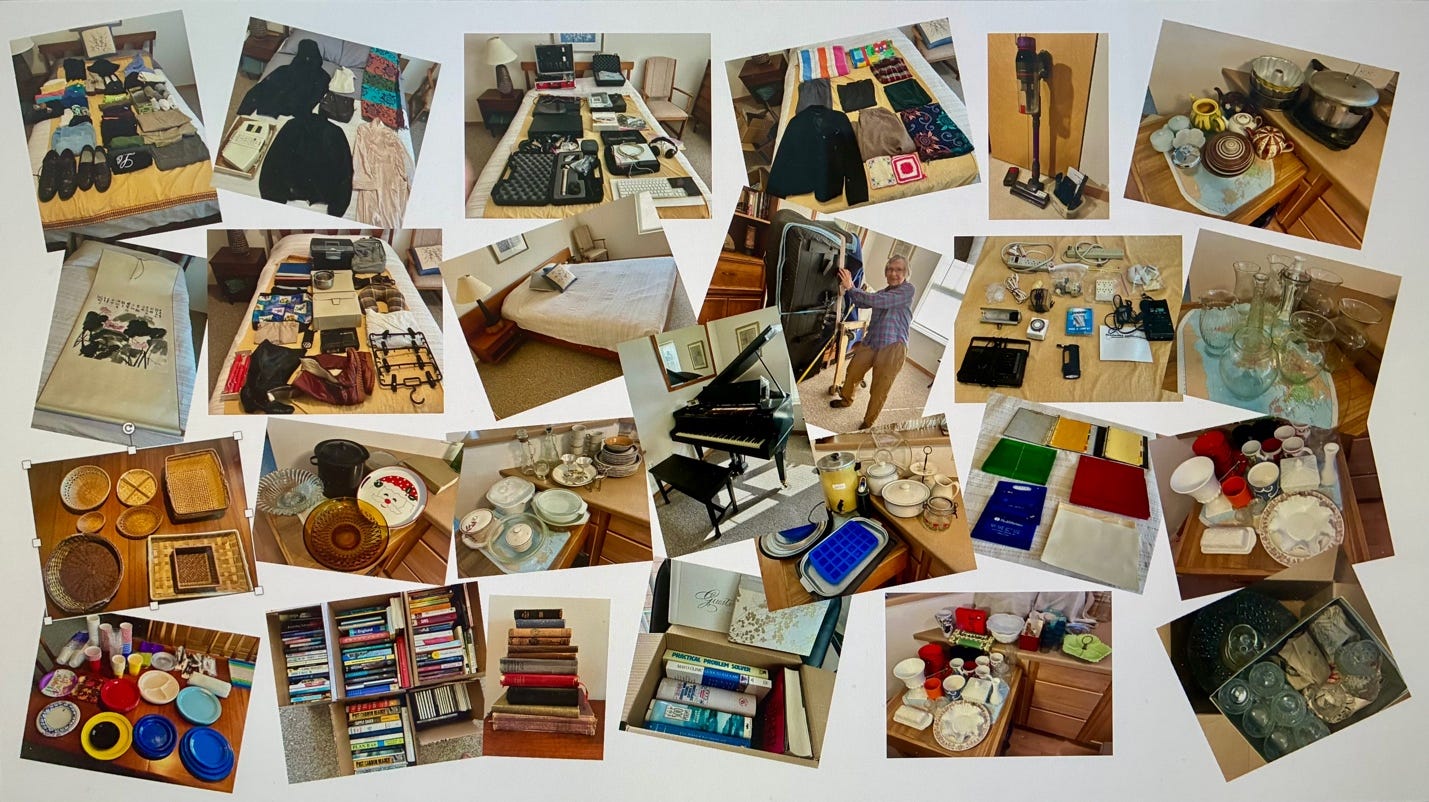
Items gifted and donated during our downsizing operation
Update
This is a sequel post focusing on downsizing possessions. The prequel post—Downsizing for Life’s Final Stage, Part 1—presented the backstory justifying our current downsizing operation. In this post I’ll explain what we’ve managed to accomplish thus far. It’s likely that some readers will have relevant information regarding personal downsizing projects to share. Be assured that any constructive comments, suggestions, or recommendations are welcomed.
To reiterate, our increasingly fragile status as an elderly couple (late 80s) is an ever-present reality, a reminder that, if we wish to continue coping well with most life activities, every aspect of our lives will require ongoing simplification. In addressing this challenge we’ve spent considerable time and effort over several weeks preparing our home for more efficient use and maintenance, as well as caregiving—if and when needed. At this time we assume most of the heavy-lifting tasks have been accomplished.
Early Condo Downsizing
It’s consistently amazing to recall the expenditure of time and effort needed in managing every single item that passes through our hands. Items classified as minutia are particularly demanding, things like the assorted screws, bolts, washers, etc. stored in our washroom’s small tool closet. While such items may be needed occasionally for specific tasks, most items lie dormant, more likely to be eventually disposed of than used.
Prior to our condo move I had donated some of my musical materials to the School of Music’s voice and opera areas, but we still had several boxes of unused materials. A few years after moving into our condo, our professional musical commitments were greatly reduced. We then undertook our first condo downsizing project, beginning with donating most of our combined music-related materials—music scores, books, recordings, etc.—to educational institutions. What remains, a greatly reduced collection of musical materials, is stored in two half-sized filing cabinets and shelves placed in our den/music room’s small closet.
We also had gradually filled four full-sized filing cabinets in our home office with numerous folders containing documents and materials related to every aspect of our long lives. Three filing drawers still contain professional materials related to past performing and teaching activities that eventually must be further reduced.
Like most older folks, we have also accumulated filing drawers containing personal business materials, including data related to tax records, financial investments, insurance, and maintenance records for home and auto. Other folders provide data related to healthcare and recreation, including past travel destinations, activities, and reports.
Alas, the amount of personal information and stuff is mind boggling, a definite downside of living in a time of plenitude, or excess. I can only surmise that older readers share similar experiences with having accumulated a lifetime of information stored in both paper and digital formats.
The digitized information stored on our computers hard drives, DVDs, and thumb drives represents a time-consuming project yet to be undertaken. I hope to plough through everything before incapacity sets in. Our main goal is to alleviate the workload of family members as much as possible upon inheriting and dealing with our estate issues.
Recent Condo Downsizing
In May, after making a list of how to proceed with downsizing, we began with rearranging the functional caregiving use of rooms and furnishings. Our master bedroom, which is large enough to hold two sets of double beds plus dressers, chest of drawers, and lamp tables, needed downsizing. Although this two-bed arrangement served us well for two decades, we decided to make room in the master bedroom for a newly-purchased rollaway bed and prepare our guest room for use by visiting family members or, if needed, a potential professional caregiver.
One lesson we’ve learned is that most American consumers, including our immediate adult family members (three sons and daughters-in-law, three grandsons and one granddaughter) are reluctant in accumulating more possessions. Still, before donating items we notify family via email, providing photos of all items to be donated. Usually, only a few items are requested.
A recent exception was our eldest son’s accepting our guest bedroom’s Scandinavian-designed teak bedroom set (bed, mattress, sheets, and matching dresser). He disassembled the complicated wooden bedframe, and with his youngest brother’s assistance hauled it away. While they were here, they willingly helped with the heavy-lifting movement of a double bed, dresser, and chest from the master bedroom. Depending on what may eventually be needed, the new rollaway bed can be placed in our master bedroom or den.
Because large items take up considerable space and limit options, we had to make an agonizing decision that Bettye found especially difficult. Our 1929 Mason & Hamlin 5’3” baby-grand piano (and stool) was an indispensable instrument for her teaching and practicing, and occasionally for arranging and composing music. This trusty piano had been in our family since the early 1970s, and, in each of three homes, it dominated the rooms it occupied.
Although Bettye’s hearing acuity over the past decade had made playing the piano an unpleasant activity, the thought of relinquishing it was emotionally challenging. Eventually, after considerable thought, we donated it to Keys 4/4 Kids, an organization providing pianos to deserving persons and organizations. As the picture below shows, the piano moving was expertly executed by two efficiently capable men provided by the organization.
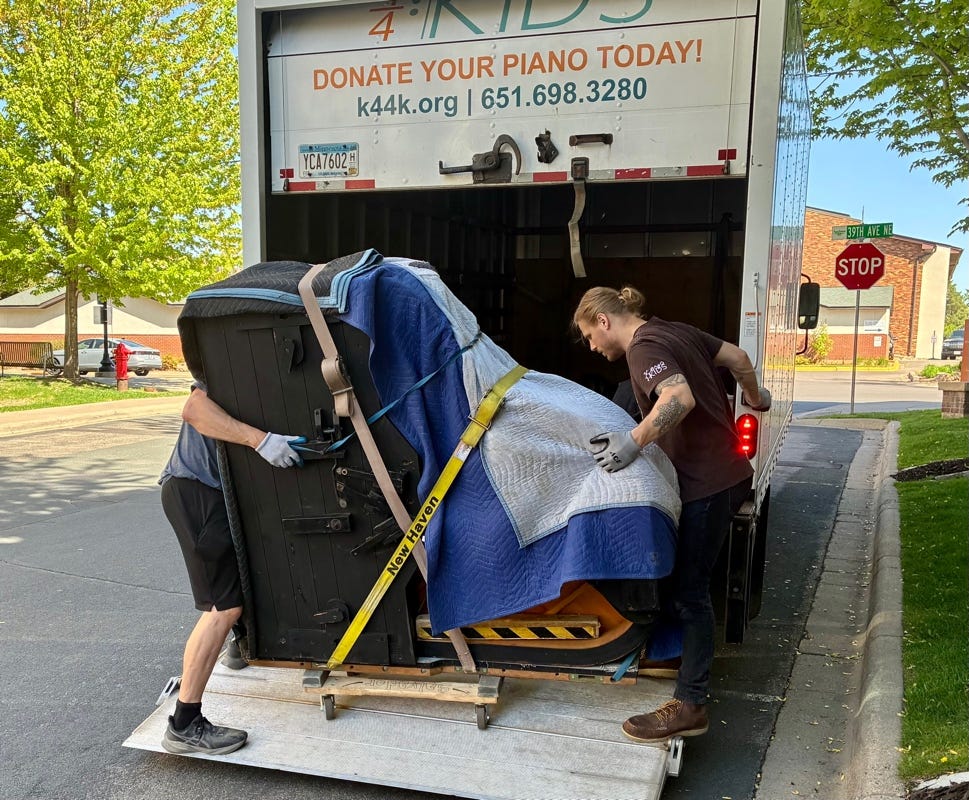
Farewell to our dear dependable piano
Throughout our downsizing operation we inspected the contents of all closets, storage areas, drawers, cabinets, and you name it. We were consistently surprised to discover items overlooked and rarely—if ever—used. A few items were gifted to family members, all of whom admit having more stuff than they can manage effectively.
In the process of combing through our large collection of cabinet files, the amount of paper documents and materials present a daunting task. Examining every document to determine what to do with it is tediously exhausting. It’s especially difficult disposing of materials that represent considerable lifelong time and energy, particularly documentation of special personal and professional activities, events, and projects.
On the other hand, we have surprised ourselves when finally deciding to let go of some items, including copies of published books, performance recordings, teaching materials, and assorted personal and professional materials.
Throughout this downsizing operation we’ve made five car trips to deliver boxed and bagged items (featured in the composite photo at the top) to two local thrift stores. While we could easily dispose of more possessions, it should be easier to accomplish now. Whew!
Wrap Up
I hope our downsizing story has proven a worthwhile read. Perhaps you have similar experiences, thoughts, and/or suggestions. If so, please feel free to share them with me. If a sufficient number of responses from readers are forthcoming, I may include them in a future post.
In the coming week I encourage you to be aware of how often personal possessions demand your time and energy. Which items are aiding or hindering you in living a simplified and focused life, one that is also meaningful, rewarding, and fulfilling?
Finally, what other downsizing objectives, methods, and techniques can you think of in helping downsize unessential possessions, the kind that interfere with pursuing your primary objectives?
In upcoming posts, I will also address some of the non-material areas of life that need downsizing—as well as some non-material qualities that could use upsizing.
Meanwhile, remain awake, aware, and open to new downsizing possibilities . . .
Clif (with Bettye Ware, reader/editor)
Sources for Downsizing and Decluttering
• Decluttering After 60: What I Lost When I Downsized My Life—and What I Found
Thank you, Clif and Bettye. Your 'story' helps make 'down sizing' more 'do-able'. Joan S.