
Thanksgiving – a Time for Celebrating Gratitude
For life’s awesome wonders, abundant gifts, and positive opportunities!

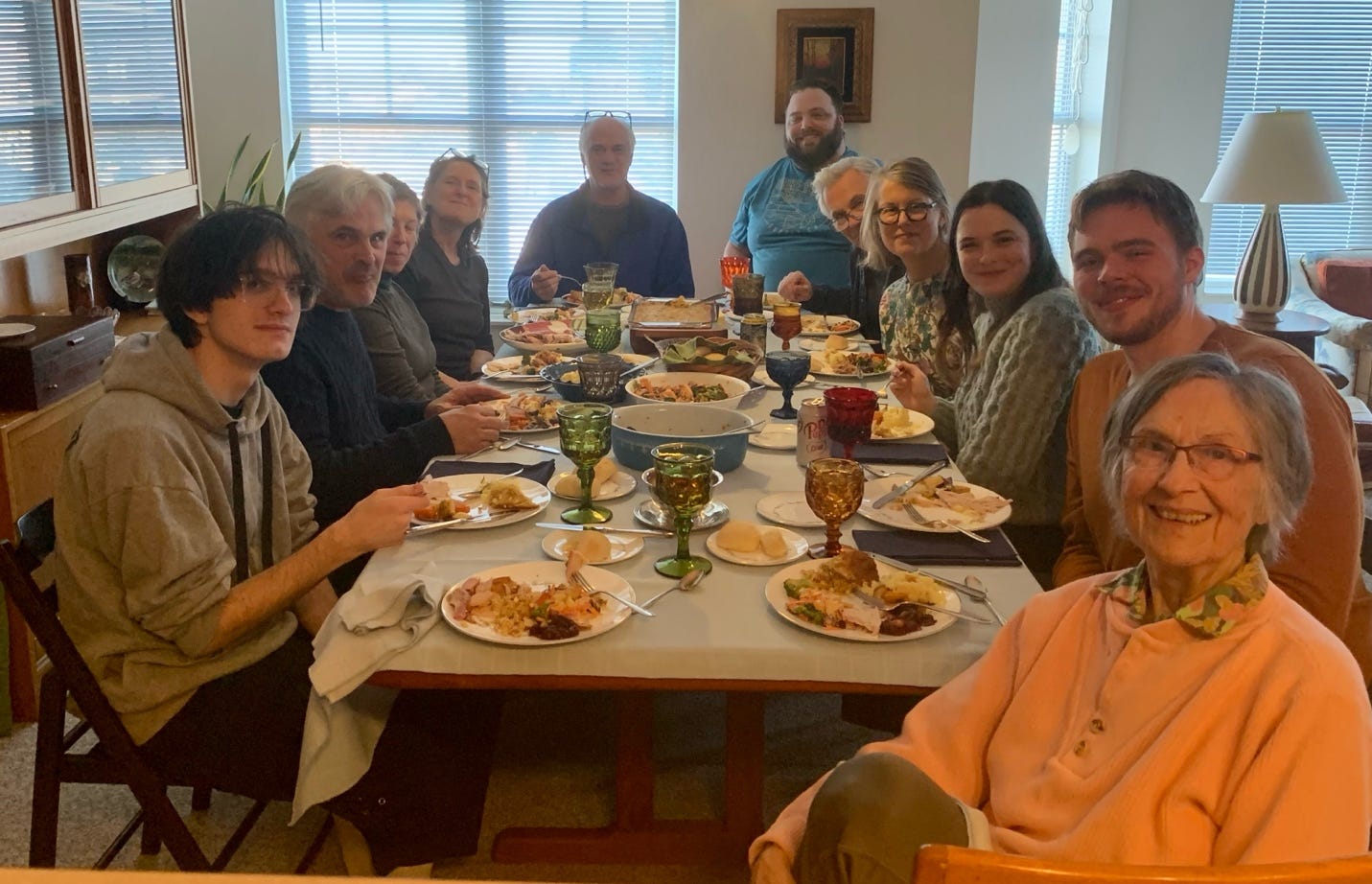
The MN/WI Ware Clan celebrating Thanksgiving ’24 (minus 2 ; 1 guest)
Recap and Backstory
Since Thanksgiving Day celebrations are nigh, I’ve decided to interrupt the intended final post of a seven-part series devoted to socio-ecological polarization issues with this special post. I’ve long considered Thanksgiving the most relevant traditional annual celebration, not only for Americans, but for all humans and beings with whom we share this precious planet. Hence, the final societal polarization post (Socio-Ecological Polarization and Personal Development) will be sent next week.
When our family members gather to celebrate on Thanksgiving Day celebration, prior to enjoying a festive meal everyone has an opportunity to share one thing for which they are thankful. Typical comments reference family, friends, health, freedom, and, of course, the prepared meal everyone’s eager to devour. I imagine most readers will have experienced a similar ritual, including a prayer of blessings.
So, having decided to write about Thanksgiving, I began pondering the many things for which I’m grateful, some of which I share later on. In the meantime, it seems appropriate to remind readers (and myself), the purpose and meaning of Thanksgiving Day, and how it came to be a national holiday.
The Origins of Thanksgiving Day
Prior to European explorer’s “discovering” this continent and the eventual settlement, predominantly by Europeans, numerous Indigenous nations practiced seasonal ceremonies of giving thanks. Since native cultures were fully embedded in Nature, they customarily expressed gratitude for community, the wonders of the natural world, and for continual renewal of existing lifeforms, food harvests, and sustainable resources.
Two prime examples are the Thanks Ceremonies of the Haudenosaunee Confederacy (ho-deh-noh-SHAH-nee; formerly Iroquois), represented today as the Haudenosaunee Thanksgiving Address, and the widespread First Fruits (Green Corn Ceremony) rituals among Eastern Woodlands tribes. While these customs were not celebrated as annual events, they served to shape cultural identity in ongoing cycles of expressing gratitude.
The first event referenced as “the First Thanksgiving” was not originally a religious event, but actually a three-day harvest gathering celebration in 1621 between the Plimoth (Plymouth) Colony’s English Pilgrim settlers and the Wampanoag people. The role of the Wampanoag tribe involved providing food, presenting local agriculture lessons, and fostering initial diplomacy efforts. Later on, the colonists held sporadic days of thanksgiving as religious fasts or feasts.
Throughout the 17th-18th centuries various colonies proclaimed days of thanksgiving as a way of recognizing military victories, drought endings, or successful harvests. As local proclamations, the events were often religious in nature. Generally, the celebratory practice of giving thanks was a hybrid blending of both Puritan traditions and Indigenous influences that shaped the views and relationships associated with the land and harvests.
The modern annual holiday can be traced largely to the efforts of author-editor, Sarah Josepha Hale, who campaigned vigorously for a unified national Thanksgiving in the mid-19th century. President Abraham Lincoln, intent on fostering unity during the Civil War, in 1863 declared the last Thursday of November a day of national Thanksgiving and Praise.
Lincoln’s proclamation remained unchanged until 1941, when the U.S. Congress established Thanksgiving Day as the fourth Thursday in November. In the decades after WWII, themes of family, abundance, national unity, and gratitude were emphasized. During this time Indigenous activists began calling attention to the need for expressing a more inclusive historical understanding, including the key role of native Americans.
Virtuous Benefits of Gratitude
An attitude founded on gratitude has been a central tenet for a meaningful life across cultures and philosophical traditions. Ancient Greek philosophers, notably Aristotle, thought of gratitude as a civic virtue essential for promoting reciprocal goodwill and community cohesion. Cicero added that “Gratitude is not only the greatest of virtues, but the parent of all others.” Moreover, all influential global religious traditions –Judaism, Christianity, Islam, Buddhism, and Indigenous worldviews – emphasize thankfulness as a spiritual orientation, not only as a feeling but more so as a practice that instils the virtues of humility, respect, and right relationship with others and the entire realm of Nature.
Research in positive psychology concludes that an attitude and expression of gratitude increases a person’s overall well-being, joy, and resilience in coping with life’s challenges. Gratitude can enhance pro-social behaviors in forming empathetic, compassionate relationships with others, and can reduce such negative attitudes as cynicism, entitlement, hate, fear, and pessimism, the attitudes that contribute to societal polarization.
A recommended article by socioecologist Richard Heinberg – Gratitude in the Great Unraveling, contains a relevant quote by Maureen Sullivan in an article for Harvard Medical School:
Recent research has pointed to gratitude’s myriad positive health effects, including greater emotional and social well-being, better sleep quality, lower depression risks, and favorable markers of cardiovascular health. Now, new data from the long-term Nurses’ Health Study shows that it may extend lives.
As for socio-ecological relevance, gratitude serves as an effective antidote to the extractive, superiority-driven worldviews of anthropocentric human supremacy. Feelings and expressions of gratitude for all of Nature’s beings and ecosystems encourages a sense of deep stewardship – and a sense of humility toward the Earth that we often take for granted.
Gratitude for Special Others, Nature, and Traditions
On a personal level, when most people relate what they are thankful for they typically begin with naming loved ones, including beloved family members, close friends, and, special teachers and mentors. Also high on the gratitude list are appreciation for good health, personal mobility, and the ability to engage in life, especially times spent enjoying moments of awesome beauty, experienced kindness, and psycho-emotional emotional insights.
Eco-centric individuals eagerly express gratitude for Nature’s marvels and the ecosystems that sustain us — the sun, clean air, soil, and water; all flora, fauna, and fungi; and all of the material resources that provide sustenance, including the food on our tables and the often-invisible people whose labor provides it. They also voice gratitude for the capacity of Earth systems to regenerate, and the interdependence of all species, reminding us we are part of a larger whole.
Gratitude is also expressed by many in support of socio-cultural and historical traditions that root humanity in something greater than ourselves. The types of applicable topics include: expressions of appreciation for the courage of ancestors who endured hardships; for the artists, poets, musicians, and writers who elevate the human spirit using their acquired knowledge, creativity, and skills; and for the scientific and technical knowledge that helps us better understand the world.
The Role of Gratitude in Developing a Qualitative Inner Life
The four areas of gratitude that most people mention include: 1) the ability to learn, grow, and change, if needed; 2) the occasions when giving or receiving forgiveness from persons having experienced or caused harm; 3) the resilience that supports us when encountering and overcoming difficult conditions or situations; and 4) for the capacity to hold gratitude in appreciation of life’s abundant gifts.
I find this qualitative inner-life development gratitude of great significance, because it provides a supportive base for appreciating life in all dimensions and domains. Rather than being a single emotion, gratitude is a complex constellation consisting of feelings, perceptions, and relational orientations that arise when we recognize the values of truth, goodness, and beauty in our lives, with the understanding that such gifts come from beyond ourselves.
Thus, gratitude encompasses several foundational psycho-emotional states, notably: love, appreciation, awe, wonder, humility, trust, safety, empathy, reverence, and acceptance. A brief explanation of each qualitative state follows.
Love, as relationship and benevolence, connotes a felt sense of connection to people, to nature, and to life itself. In this sense love is not romantic but relational, that is, an awareness we are supported and valued by others as fundamentally interdependent beings willing and able to give and receive help, a response that’s not always easy for self-reliant individuals. In sum, love widens the heart’s capacity to notice goodness and to respond with appreciation. Thus, without love gratitude becomes mere politeness; but with love gratitude becomes transformative.
Appreciation of value is the active perception of goodness in others, in experiences, or in the wider world. Psychologically, appreciation includes: mindfulness (present-moment awareness); valuation (recognizing something as “good,” “meaningful,” or “precious”); and savoring (allowing the positive experience to sink in). Appreciation may be considered the cognitive engine of gratitude, as when fleeting positive moments become meaningful.
Awe may be thought of as an emotion of overpowering vastness and humility, a stunning moment that arises when we encounter a phenomenon greater than ourselves – a star-spangled night sky (Milky Way), a forest of towering trees, an expansive natural scene, or a profound act of goodness. The key components of awe that support gratitude include: self-transcendence, the feeling part of something larger; humility, the loosening of ego’s grip; and perceptual expansion of increased openness and curiosity. The attitude of awe leads to gratitude because it reshapes the self from the state of “I deserve” to “I receive.”
Wonder, a mix of childlike curiosity, respect, and reverence for mystery, helps us remain receptive to surprises, renews our perceptions of ordinary elements and happenings, and allows us to experience life as gift rather than entitlement. It seems that, while awe inspires a sense of magnitude, wonder inspires an openness to complexity. Both emotional responses broaden the meaning of gratitude’s ecological and philosophical dimensions.
Humility is essentially a self-recognition and authentic self-understanding of our human dependences and limits. Its role in fostering gratitude involves acknowledging that we are not entitled to special treatment, and are deeply dependent on the generosity of others. As such, being grateful makes us more receptive to receiving help, generosity, and other forms of goodness and beauty. According to author and pastor Joyce Meyer: “Humility is not something that comes naturally. But it is a cardinal virtue that should be pursued more than any other.”
Trust (and safety) provide the emotional content of gratitude, because to feel grateful we must be able to relax vigilance, perceive goodwill instead of threat, and allow vulnerability in receiving assistance from others. Living in a state of chronic fear or trauma can stifle gratitude because our nervous systems are oriented toward protection, not openness. In short, a sense of safety allows a person to remain open to receiving assistance from others, which creates the emotional conditions for having gratitude.
Empathy allows us to understand the intention behind someone’s positive action, respond to the human warmth behind positive gestures of others, and sense the mutual benefit of personal relationships. The power of empathy can help transform gratitude from personal emotion into social cohesion.
Reverence is an expression of gratitude across cultures, often arising from a sense of the sacred in life, broadly defined as not necessarily religious, but marked by something that’s especially significant to a person. For instance, having a sense of reverence can make even common elements like water, food, sunlight, and friendship feel like profound gifts rather than mere conveniences. So, reverence, plus humility, plus appreciation, equals enduring gratitude.
Acceptance essentially means letting go of control, especially when confronting any task or situation beyond normal human capabilities. Gratitude simply requires a degree of acceptance of what life presents to living beings, including understanding we cannot control all outcomes, embracing what we have and receive rather than lamenting over what we lack, and facing reality with openness instead of resistance. Gratefully, acceptance can turn the unpredictable nature of life into a source of meaning rather than resentment.
In sum, these aspects of gratitude work together and flourish when they reinforce one another. Thus, love and empathy create relational trust and respect; awe and wonder expand perception; humility and acceptance quieten the ego; appreciation and reverence illuminate the value of things; and safety enables vulnerability and receptivity. Together they form what psychologists call a “gratitude disposition”—a steady, overarching orientation to life that supports psycho-emotional health, ethical behavior, and socioecological awareness.
Wrap Up
Each of us has a special something for which we are most grateful. The type of gratitude I prefer is addressed in the previous section, in relation to developing a qualitative inner life. For me, gratitude begins with embracing a deep appreciation for life, for everything that exists, plus a deep appreciation for the evolutionary processes that made it possible for consciousness to emerge and expand with homo sapiens.
Next, I am grateful for having been born to loving, caring parents who provided a healthy genetic inheritance and socio-cultural nurturing that have enabled me to learn, grow, and develop the essential life skills for coping effectively with the challenges presented in an exciting age of human development. Naturally, I’m very grateful for the lifelong love and support of family members, teachers, mentors, and influential persons who have provided aid and guidance on my life’s journey.
As an elderly fellow, I’ve been fortunate to enjoy an active retirement life, allowing time to explore new interests and pursuits, the types of experiences that foster learning, reflection, appreciation, and enjoyment of life’s many wondrous dimensions on one-of-a-kind planet home named Earth.
For certain, I’m most appreciative for your having joined me in exploring various aspects of gratitude, and I hope we can meet (in spirit) next week for the final post of socio-ecological polarization. Meanwhile, I encourage you to ponder everything for which you are grateful. Even better, how about noting your thoughts for future reference?
Finally, I share a unique gratitude exercise I learned from Jerry Hoffman, a former neighbor, friend, and retired pastor. Once, when greeting him with the standard “How are you, Jerry?”, he cheerfully replied with “I’m grateful, thanks! And you?”
When celebrating gratitude this Thanksgiving Day 2025, how about using this response when someone greets you with “How are you”?
Yours, gratefully . . .
Clif (with Bettye Ware, reader/editor)