
Spaceship Earth – How SCOPE Affects Social and Ecological Systems
Why scope matters in creating a resilient and sustainable future

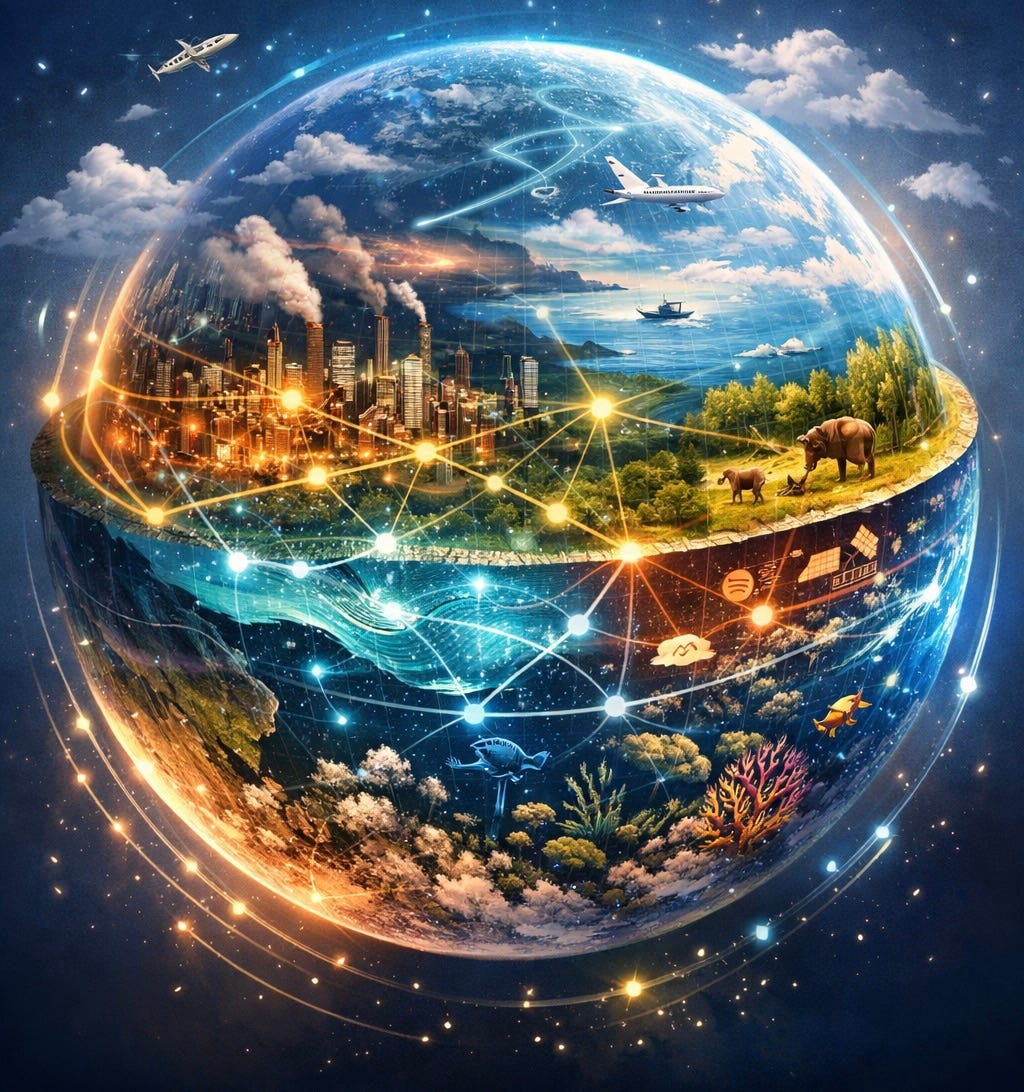
Image: ChatGPT
Recap
This is the third post in a six-post series devoted to exploring how the four dimensions of size, scope, scale, and speed are illustrated using the Spaceship Earth metaphor. A key concept of this series requires awareness of our human role as Earth’s crew, with total responsibility for assuring a safe, secure, and sustainable voyage.
The first post, Spaceship Earth – A Metaphor for Our Planet and its Passenger-Caretakers, introduces this series, and the second post explains why SIZE matters in creating a stable and sustainable existence. Both posts provide background information relevant to understanding all four dimensions and how they interrelate and reinforce one another.
As suggested in the title, the dimension of Scope emphasizes the systemic interrelationships that function in wide-ranging ways and contexts throughout human society and across the natural environment. Our goal here is to explore the various forms of scope in relation to the three dimensions of size, scale, and speed.
Of the four dimensions, I find that scope is the hardest of the four dimensions to explain and understand, precisely because it deals with simultaneousness (occurring at the same time), interdependence (inseparable, mutually reinforcing), and invisibility (overlooked) rather than quantities or rates. Thus, size can be counted, scale can be mapped, and speed can be measured, but scope has to be grasped.
Various Types of Modern Scoping Devices
Historically, our human curiosity has induced our species to invent and improve mechanical devices that enable us to see more of everything. It’s possible to view the smallest lifeforms (bacteria and viruses) and, when using electrons and lights, to view sub-cellular and atomic entities down to the 0.05 nanometers. At the more expansive scope spectrum, it’s possible to view far-distant objects in space, including galaxies. All forms of mechanical scoping are amazing devices for exploring the physical world.
Scientific inquiry has been advanced by optical instruments designed to magnify, visualize, or project images, as categorized by their application, magnification power, and underlying technology. The most simply constructed, low-tech scoping devices are Kaleidoscopes, entertaining devices used for viewing colorful, shifting, mesmerizing patterns. Children, in particular, seem to benefit from having their imaginations stimulated, creativity enhanced, and visual perception sharpened.
The most familiar practical types of scopes are: microscopes for viewing extremely small entities; telescopes for viewing distant objects; and periscopes for viewing anything out of sight, as in submarines and tanks. Other purposeful scoping devices include: optic-scopes for weapons (guns); endoscopes for viewing inside bodies of animate beings; stethoscopes for detecting heart and lung sound (blood flow and circulation); otoscopes for viewing ear, nose, and throat; gyroscopes for detecting orientation in space; and borescopes for viewing in hard-to-reach places.
Scope – The Expanding Reach of Human Systems
Generally, scope is concerned with all social and ecological systems that are in play at the same time – and everything that happens when they interact. All systems involved are co-dependent, and cannot fail independently. In brief, a scoped failure is not the collapse of a single system, but a cascade that affects all systems.
Two principal ecological examples are illustrated with climate change and biodiversity loss. Earth’s changing climate has far-reaching simultaneous effects on many systems – the chemistry of the atmosphere, ocean temperatures and acidity levels, ice melt and sea-level rise, freshwater availability, soil moisture, species migration and extinction, food systems, and disease vectors. In short, all ecological and social systems are affected.
Likewise, biodiversity loss systemically affects pollination, soil fertility, carbon sequestration, water regulation, food webs and disease resistance. Ecosystems lose both their natural beauty and their functional redundancy when multiple species perform similar roles or functions in an ecosystem, making them substitutable. The loss of one species is a minor event, but the loss of relationships is a systemic failure.
With this in mind, scope refers to the ranging reach of something in terms of breadth, depth, and boundaries in defining what is included and, importantly, what is excluded. It also sets the limits for things, including systems, actions, consequences, projects, researches, concepts, etc., that effectively determine the range of what is to be considered – geographically, economically, socio-culturally, ecologically, and temporally. In today’s complexly interconnected world, the scope of human activity has expanded dramatically. What once was local now ripples across the globe.
Understanding scope is vital to living sustainably. Failing to account for the true reach of our actions could result in harmful outcomes that perpetuate unsustainable practices. In seeking accurate analyses of any human activity, the dimension of scope can help determine resources needed, in addition to the anticipated input of energy, time, and human effort.
Imagine holding a plastic water bottle in your hand. While its contents serve an immediate local purpose, its scope is actually global. For instance, oil drilled in the Middle East can be refined into plastic in Asia, molded in a factory thousands of miles away, shipped worldwide, and discarded into landfills — or end up polluting soil, streams, and oceans for centuries. A single bottle illustrates how, in the scope of modern life, our actions extend far beyond our limited perspectives.
Societal Scope – In Relation to Size, Scale, and Speed
In our modern human societies, size refers to the magnitude of the work involved, often measured in volume, budget, efficiency, or the sheer quantity of tasks. A “larger” scope generally means that more (or different) things are included in the project, all of which directly increase its size.
For example, when building a house, the scope dimension includes all rooms, functions, and features (sleeping, cooking, bathing; plumbing, electricity, etc.), and the size dimension is determined by total square footage. If the scope increases, as with adding a garage or carport, the size must also increase in overall effort and materials.
Scale refers to the size, extent, or intensity of operations, and is often about doing the same thing over and over again, as occurs in mass production. While scale focuses on volume, scope focuses on the variety of items within that volume. For example, a large-scale project might involve producing 10,000 unique gadgets, while a large-scope project could be producing 100 different types of gadgets. Thus, economies of scale reduce costs by increasing production volume, and economies of scope reduce costs by producing a wider range of products.
Speed relates to how fast deliverables can be produced, often directly linked to efficiency or the velocity of work. Scope directly impacts speed, with a broader scope usually reducing speed, and a tighter scope increasing it. If the scope of a project (the workload) increases without adding more resources, the speed of delivery will decrease. To maintain high speed, a narrow scope is necessary, as when building a single home vs. building many homes, which requires more workers, resources, and time.
Unlike older local systems, modern society’s expanding technologies and corporations have global scope, with global-supply chains that restrain local self-reliance. Globally, all societal systems are affected. The scientific scope shifts from micro to macro levels; the educational scope shifts from universal access to fragmentation and narrow specialization; and the socio-cultural scope vacillates between fundamentalistic, traditional worldviews and liberal, scientific worldviews.
Ecological Scope – In Relation to Size, Scale, and Speed
In a final analysis, the most critical scope relates to ecological concerns. An undeniable reality is the interconnectedness of all Earth systems. Examples: Indonesian deforestation alters global carbon cycles and rainfall patterns; Mississippi Basin’s agricultural runoff creates a dead zone in the Gulf of Mexico; and toxic emissions in one nation alter the climate globally (“what goes around, comes around”). This entanglement of systems means that no ecosystem, including human society, exists in isolation.
Renowned naturalist and Sierra Club founder, John Muir, reinforced this concept in 1911, when he stated this: “When we try to pick out anything by itself, we find it hitched to everything else in the universe.”
Geographically, scope plays a key role. Traditional societies, notably ancient hunter-gatherers, lived primarily within local ecosystems, with basic needs (food, water, shelter) gained from nearby sources. In contrast, modern societies rely mostly on global supply chains that travel thousands of miles transporting practically everything needed and desired by humans worldwide. A smartphone, for example, may include components mined in Africa, shipped and assembled in Asia, and shipped again by an international company to be sold in the U.S.
Temporally, the scope of many modern actions produces consequences that extend across decades or centuries. Carbon dioxide lingers in the atmosphere for centuries, microplastics (PFAs) continue accumulating in all systems, and radioactive waste persists for millennia. Conversely, the scope-related impacts of pre-industrial actions, as in building a wooden home, farming a field, and raising livestock, were largely immediate and local.
Our socio-cultural choices affect not only local communities but distant people. Our normal modern-day consumptions involve purchases of wide-ranging goods from afar, including fast-fashion items that exploit labor in a poor foreign country, consuming beef, which contributes to inhumane factory-farming, and the pollution of air, water, and soil.
And then there’s social media, the magna-amplifying scope of both beneficial and harmful content, with a single post instantly reaching millions of people across the globe. Unfortunately, the scope of shared misinformation and disinformation augments polarization, in turn shaping peoples’ attitudes and beliefs.
Enlightened individuals prefer that science and education offer a scope of knowledge that is broad (and deep) in context. Knowledge expands the scope of anything, as when telescopes reveal galaxies, microscopes uncover DNA, and climate science reveals global interconnections. As the scope of knowledge broadens, so do concern and responsibility for applying newfound knowledge morally and ethically.
Understanding and taking responsibility for the full scope of our actions means careful consideration for any long-term consequences. One thing to watch for is “scope creep”, the uncontrolled, unauthorized growth of a project’s scope. The addition of features or tasks – without corresponding adjustments in budget, time, or resources – is a major cause of projects going over budget or falling behind schedule.
Having a sustainable life requires recognizing how the scope of human activities is planetary. Actions taken in one place reverberate in a domino effect across the globe, as happens with the devastating effects of diseases, deforestation, extinctions of flora and fauna species. And we cannot overlook the multiple effects of climate change, especially the whiplashing extremes of heat, floods, forest fires, melting ice regions and sea-level rise, and so on.
The Problem of Narrow Visioning – and Scope Right-Sizing
Along with the other dimensions featured in this series, our human institutions often ignore scope. Corporations focus narrowly on profits, blissfully ignoring ecological and social costs that lie beyond their balance sheets. Governments prioritize short-term national interests over global well-being. And individuals focus on self-interests (“what’s in it for me”) without considering wider consequences. I think you’ll agree that this mismatch between the true scope of impacts and the limited scope of our awareness is a root cause of growing poverty and unsustainable global living conditions.
Aligning our awareness with the true scope of our actions is possible, but will require pursuing four major strategies: 1) Re-localization, which shortens supply chains and encourages the development of local food and energy systems; 2) Global responsibility, with nations acknowledging all planetary consequences and agreeing to collectively cooperate on crucial issues, including climate change, ocean protection, and biodiversity conservation; 3) Temporal responsibility, which requires adopting long-term thinking and planning, with the goal of providing a sustainable future for the seventh generation, over that of economic and financial profits; and 4) Holistic education that features critical systems thinking in helping citizens understand the interconnected scope of ecological, economic, and social systems.
Some scope-specific strategies for improving our chances in shaping a sustainable future are readily available. Fair Trade expands consumer awareness to include distant producers, and carbon labeling shows the global scope of local purchases. More often these days, many indigenous worldviews serve as models for holistic scoping, including an emphasis on the interconnectedness of humans and Nature across space and time. And local food networks help narrow geographical scope within planetary awareness.
Wrap Up – Living Responsibly Within Scope
Although our actions now involve planetary scope, our thinking remains focused on provincial self-interests. The scope of human activity in our modern highly complex world has expanded dramatically over the past 100 or so years. Communities once lived mostly within the limits of their local ecosystems. But today our choices ripple across continents and centuries. If we wish to act within the true scope of our impacts — across space, time, and community — we need to do whatever is needed in restoring balance on our finite Spaceship Earth.
Understanding scope — the range or reach of our actions — is essential to future sustainability. By doing so, we may learn to act not as isolated individuals or nations, but as members of a global community bound to the same planet home. Sustainability requires living with full awareness of how scope affects every action we take – far beyond ourselves. According to systems theorist, Fritjof Capra:
The more we study the major problems of our time, the more we come to realize that they cannot be understood in isolation. They are systemic problems, which means that they are interconnected and interdependent.”
In the next post we’ll explore the dimension of scale in relation to societal and ecological issues. There’s a plenty of information to digest and apply during our lifetime voyage on Spaceship Earth. I hope all readers find the journey a personally exciting and worthwhile exploration of concepts, meanings, constructive strategies, and effective applications in creating a stable and sustainable future – for all fellow travelers on Spaceship Earth.
Bon voyage . . .
Clif (with Bettye Ware, reader/editor)